Who owns the Intellectual Property?All’s Fair in Love, War… and Copyright

By Zinta Strydom and Jasmine Sikhosana
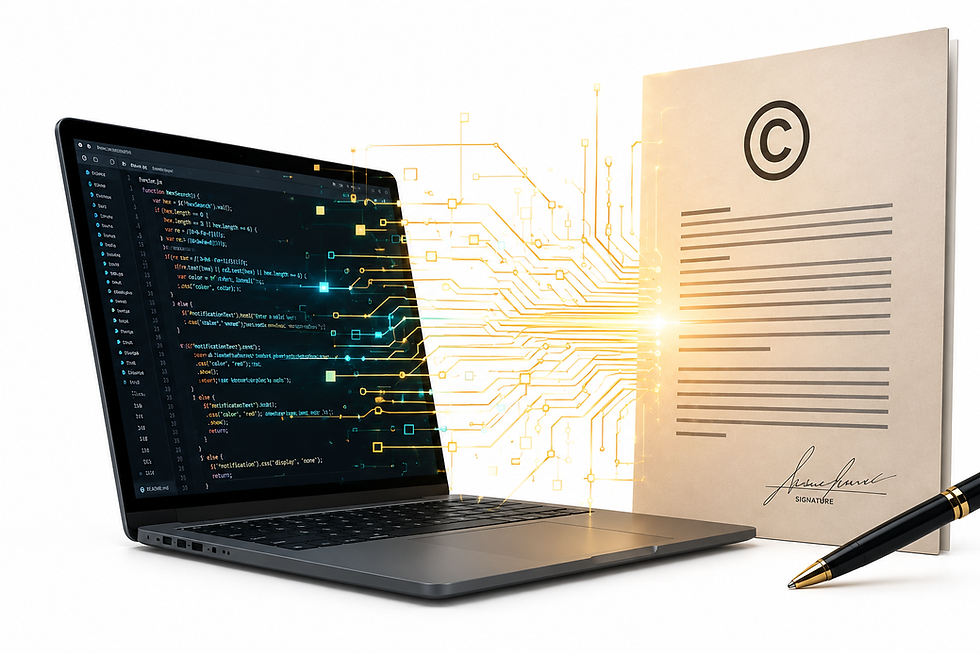
Businesses are increasingly using AI or software programs to create marketing content and compare programs, designs, software, and documents, but who owns the intellectual property? Does the copying of programs or use of AI amount to copyright infringement?
Section 19B of the Copyright Amendment Bill (CAB) in South Africa introduces statutory exceptions to copyright infringement specifically for computer programs. It permits users to study, test, or evaluate a program to understand its underlying principles and allows for code reproduction or translation necessary to achieve interoperability.
With the Constitutional Court confirming the constitutionality of sections 12A and 19B of the Copyright Amendment Bill, South Africa enters a new era of fair use - reshaping how technology businesses develop software, integrate platforms, leverage copyrighted content, and protect their intellectual property.
The Copyright Act 89 of 1987 was initially formulated around the principle of "fair dealing," a closed and prescriptive system that permitted the use of copyrighted works only for a limited number of specifically defined purposes, such as research, private study, criticism, review, and the reporting of current events. However, the advent of the Copyright Amendment Bill (‘’CAB’’) is a paradigm shift, transferring the once rigid and somewhat limited framework to a more flexible, principles-based approach that affords greater flexibility to innovation, education, technological development, and digital creativity, while continuing to safeguard the legitimate interests of copyright owners through judicial oversight and a case-by-case assessment of fairness.
Section 12A(a) of the CAB provides a nonexhaustive list of illustrative purposes for which fair use may apply, namely:
research, private study or personal use, including the use of a lawful copy of the work at a different time or with a different device;
criticism or review of that work or of another work;
reporting current events;
scholarship, teaching and education;
comment, illustration, parody, satire, caricature, cartoon, tribute,
homage or pastiche;
preservation of and access to the collections of libraries, archives and
museums; and
ensuring the proper performance of public administration.
That said, inclusion of these purposes does not automatically render a use lawful. Rather, section 12A(b) of the CAB requires a court to undertake a holistic assessment of all relevant factors to determine whether the particular use of the copyrighted material is fair. The factors that the court must consider are:
The nature of the copyrighted work;
The amount and substantiality of the portion used in relation to the work as a whole;
The purpose and character of the use, including whether the use is transformative by serving a purpose different from that of the original work and whether it is commercial or undertaken for non-profit research, library or educational purposes; and
The effect of the use on the potential market for, or value of, the original work.
In addition, section 12A(c) requires that, where practicable, the source and the author's name be acknowledged. Altogether, these sections transform the enquiry from one based on rigid statutory categories into a nuanced balancing exercise, requiring courts to weigh the interests of copyright owners against the broader public interest in creativity, innovation, education, and freedom of expression on a case-by-case basis.
In addition to introducing a general fair use doctrine through section 12A, the CAB expands South Africa's copyright limitations and exceptions by introducing several specific statutory exceptions, including exceptions relating to computer program interoperability, libraries and archives, and persons with disabilities. For technology companies, software developers and SaaS providers, however, the most commercially significant of these new statutory exceptions is section 19B of CAB, which introduces a limited interoperability exception for computer programs.
Who owns the intellectual property? This depends on a number of things:
· How a program or AI is used?
· Existing agreements?
· Terms of the platform; and
· South African Intellectual Property.
In recognising that modern software development frequently requires interaction between independently developed systems, section 19B of CAB permits a lawful user of a computer program to observe, study, and test the functionality of that program to determine the ideas and principles underlying its operation while carrying out authorised acts such as loading, executing, or storing the software. More significantly, the provision permits the limited reproduction and translation (decompilation) of source or object code where this is indispensable to obtain the information necessary to achieve interoperability between an independently created computer program and another program. This exception is, however, subject to strict safeguards, as it only applies where the information is not otherwise readily available; the reproduction is confined to those portions of the code strictly necessary to achieve interoperability, and the information obtained may not be used for any purpose other than interoperability, shared beyond what is necessary, or used to develop or market a substantially similar competing program.
For example, where a cybersecurity company develops a platform that must integrate with a customer’s existing SIEM, section 19B of CAB now lawfully permits the software developer to analyses the SIEM's functionality and reproduces only the limited code necessary to understand its interface, provided that the information is used solely to achieve interoperability and not to develop a competing SIEM product.
On the one hand, this section provides greater legal certainty for organisations developing APIs, middleware, software integrations, cloud platforms, fintech solutions, cybersecurity products and enterprise software that must interact with third-party systems without infringing copyright. On the other hand, software vendors can no longer rely solely on copyright law to prevent legitimate interoperability activities. It is therefore advised that related affected technology businesses review their intellectual property strategies by strengthening software licence agreements and EULAs, protecting confidential source code and trade secrets, and keeping clear development records to distinguish proprietary software from functionality developed solely to enable interoperability.
Likewise, organisations that undertake reverse engineering should adopt internal policies documenting the legitimate interoperability purpose of any code analysis, ensuring that only the minimum amount of code necessary is reproduced and that the information obtained is never repurposed for developing competing software.
Although section 19B promotes innovation and competition within South Africa's software ecosystem, it does not create a general right to copy computer programs; rather, it establishes a carefully circumscribed exception that balances technological advancement with the continued protection of software developers' intellectual property rights.
Key Takeaways for Technology Businesses:
Review software licence agreements and EULAs to address interoperability and reverse engineering.
Protect proprietary algorithms and source code through contractual confidentiality obligations rather than relying solely on copyright.
Document legitimate interoperability activities to demonstrate compliance with section 19B.
Ensure developers only reproduce the minimum code necessary and do not use the information to create competing software.
Consider whether APIs or licensed SDKs can achieve interoperability before resorting to decompilation.
The Constitutional Court's decision signals that South Africa's copyright framework is evolving alongside the digital economy. For technology businesses, the changes present opportunities for innovation, but they also require a review of software licensing, intellectual property strategies and development practices to ensure continued compliance while protecting valuable software assets.
For more information, please contact Zinta Strydom, Managing Director.


Comments